

Treatment options for central sleep apnea
Central sleep apnea (CSA) is a complex sleep-disordered breathing condition that can be challenging to diagnose and manage, with patients often experiencing fewer or different symptoms than those with obstructive sleep apnea (OSA).
Explore the role of adaptive servo-ventilation (ASV)* in CSA treatment, including key considerations for patient selection.
Choosing the right therapy for CSA
CPAP/APAP therapy is often used as a first-line treatment for central sleep apnea (CSA), but it may not adequately control respiratory events or improve symptoms in all patients. For appropriate patients, adaptive servo-ventilation (ASV*) may be considered either as an initial treatment option or after an unsuccessful trial of other positive airway pressure (PAP) therapies.1
Full polysomnography remains the gold standard for diagnosing CSA and differentiating central events from obstructive sleep apnea and other sleep disorders. A diagnosis of central sleep apnea is made when:
- central apneas or hypopneas constitute 50% or more of the respiratory events,10 and
- the central apnea index is 5 or more per hour of sleep10
How prevalent is central sleep apnea?
According to a very large observational analysis of Resmed's American AirView database, which includes 133,006 patients receiving CPAP therapy:
3.5%
of patients receiving CPAP therapy had emergent, transient or persistent central sleep apnea with central apnea index (CAI) > 5.2
Transient CSA
CAI ≥ 5/h in week 1, < 5/h in week 13
Persistant CSA
CAI ≥ 5/h in week 1, ≥ 5/h in week 13
Emergent CSA
CAI < 5/h in week 1, ≥ 5/h in week 13
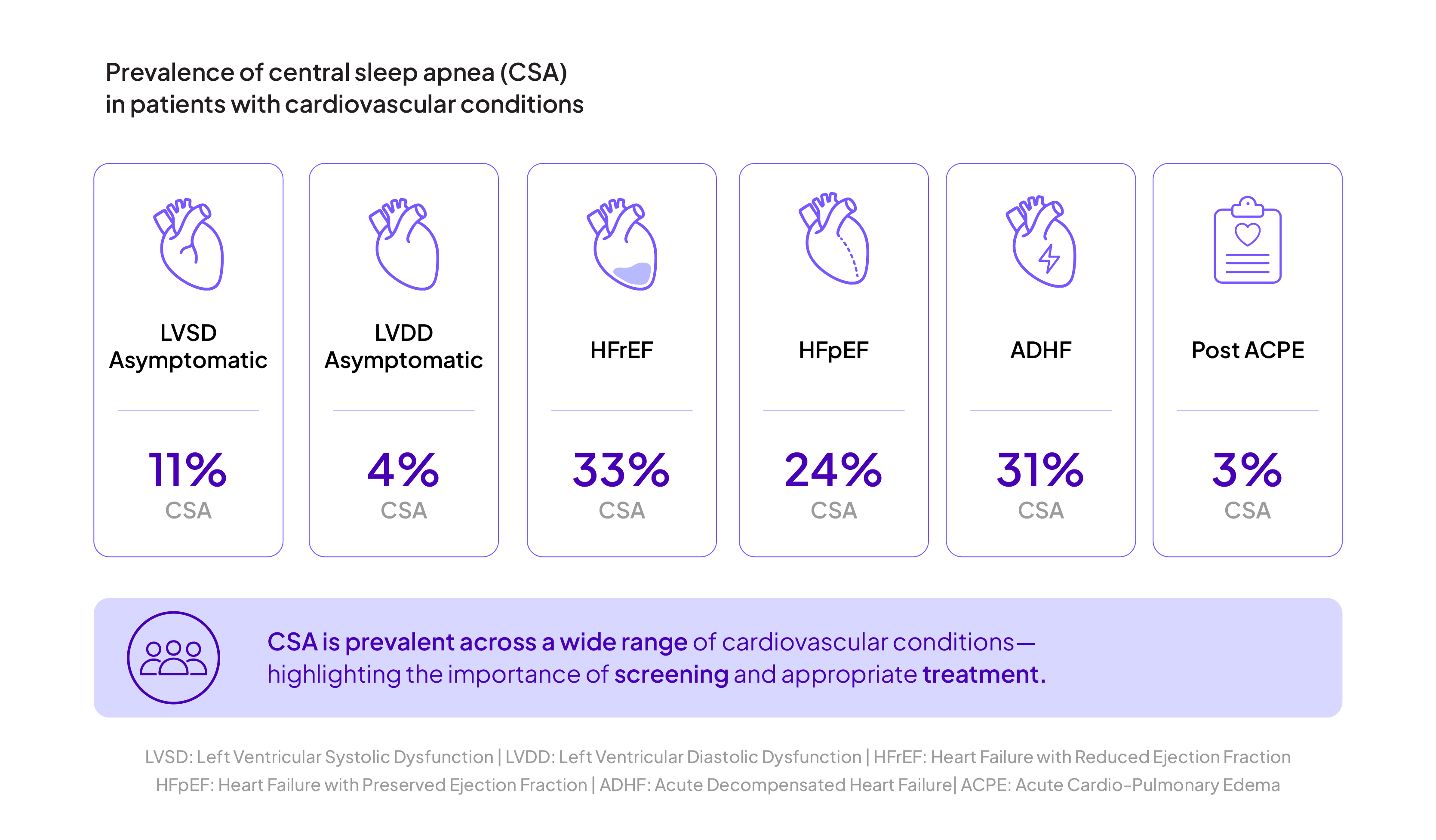
Up to 45%
5-12%
CSA prevalence in cardiovascular disease (CVD) patients:5
Adaptive-servo ventilation: a proven solution for CSA
Continuous positive airway pressure (CPAP) or automatic positive airway pressure (APAP) therapy may reduce respiratory events in some patients with CSA. However, CPAP/APAP does not consistently eliminate central apnoes or improve symptoms in all patients, particularly in complex or treatment-emergent CSA.
Adaptive servo-ventilation (ASV)* is an evidence-based therapy designed to stabilise breathing patterns in appropriately selected patients with CSA. ASV dynamically adjusts pressure support in response to the patient’s ventilatory needs throughout the night.
ASV may be considered, depending on clinical evaluation, contraindications and local guidance, for selected adults with several forms of CSA, including:
-
Primary CSA
-
Treatment-emergent CSA
-
CSA associated with medical conditions
-
CSA related to medication or substance use
Treatment decisions should remain individualised and based on clinical evaluation, underlying aetiology, symptom profile, cardiac status, contraindications and shared decision-making between clinician and patient.
Clinical studies have shown that compared to other forms of PAP therapy, ASV can reduce central respiratory events in selected patients with CSA. This has been demonstrated in multiple clinical trials across various patient types.
ASV improves outcomes
Sleep improvement (PSQI, FOSQ)
Disease-specific QoL improvement (SF - 36, Pichot Fatigue Scale)
Reduced sleepiness
LVEF and patient selection
Assessment of left ventricular ejection fraction (LVEF) forms part of the broader clinical evaluation when considering ASV therapy.
Patients with LVEF >45% may be considered for ASV therapy when clinically appropriate and in the absence of contraindications.
In patients with heart failure and reduced ejection fraction, treatment decisions should follow current guideline recommendations and specialist clinical judgement, with careful monitoring and follow-up.
Phenotyping identifies patients who may benefit most from ASV
In heart failure (HF) patients with CSA, ASV outcomes varied by clinical phenotype.
In the FACE registry (503 HF patients), six phenogroups were identified and three were associated with favourable prognosis and high adherence under ASV therapy.8,9
How to treat patients with central sleep apnea
Discover how Resmed's adaptive Servo-Ventilation (ASV) solution promotes harmony, safety and comfort.
CPAP, APAP and bilevel therapy
Positive airway pressure therapy can be delivered in a number of modes:
- Continuous positive airway pressure (CPAP), which delivers air at a fixed pressure.
- Automatic positive airway pressure (APAP), which automatically adjusts pressure levels based on a patient's breathing. APAP may be suitable for patients with REM-related sleep apnea, positional apnea or who experience non-compliance with standard CPAP therapy.
- Bilevel therapy, which provides higher inspiratory pressure (IPAP) and lower expiratory pressure (EPAP) - can also be effective for certain OSA patients who are non-compliant, and used to treat a wide-range of sleep and respiratory disordered breathing other than OSA such as include CSA, overlap syndrome, COPD, and more.
Patient outcomes and comorbidities
Helping your patients start and continue with the most effective sleep apnea treatment can help them regain control of their lives. Effective treatment has been shown to reverse the effects of daytime sleepiness, fatigue, moodiness and depression. And studies have shown that when patients are successful with their therapy, their long-term health care costs are at least 50% lower overall.1
There are also a variety of serious comorbidities such as cardiovascular disease, diabetes and stroke that have a strong connection to sleep apnea.
Positive airway pressure (PAP) therapy
Positive airway pressure therapy is widely regarded as the most effective way to treat OSA.1 It works by creating a "pneumatic splint" for the upper airway, preventing the soft tissues of the upper airway from narrowing and collapsing. Pressurised air is sent from a therapy device through air tubing and a mask that patients wear over their nose or mouth, through to the upper airway.
As a result of positive airway pressure therapy, a patient with severe sleep apnea may experience a return to a normal sleep pattern once his or her sleep debt resolves.
Resmed's AirSense and AirCurve series of devices have helped patients sleep through the four hour compliance threshold. AirSense and AirCurve devices are stylish and quiet, and provide a variety of unique features that are designed to deliver a more comfortable sleeping experience for your patients.
CPAP, APAP and bilevel therapy
Positive airway pressure therapy can be delivered in a number of modes:
- Continuous positive airway pressure (CPAP) - which delivers pressurised air at one fixed pressure.
- Automatic positive airway pressure (APAP) therapy - which automatically adjusts pressure levels based on a patient's breathing patterns. This may be particularly suited to patients with REM-related sleep apnea, positional apnea or those who are non-compliant with standard CPAP therapy.
- Bilevel therapy - which provides higher inspiratory pressure (IPAP) and lower expiratory pressure (EPAP) - can also be effective for certain patients who are non-compliant, and used to treat a wide-range of respiratory disorders.
Oral appliance therapy
An oral appliance, often called a mandibular repositioning device (MRD), can be a second line therapy option and can be considered for patients with mild to moderate sleep apnea. It is a custom-made, adjustable oral appliance available from a dentist that holds the lower jaw in a forward position during sleep. This mechanical protrusion expands the space behind the tongue, puts tension on the pharyngeal walls to reduce collapse of the airway and diminishes palate vibration.
Alternative treatment options
Surgery is also an option for treating sleep apnea, but as with all surgeries there are associated risks.
Uvulopalatopharyngoplastry (UPPP) has been widely used to treat snoring or OSA, but is not recommended as the first choice treatment option2. This surgical procedure involves the removal of the tonsils, soft palate/uvula and closure of the tonsillar pillars and certain risks are involved3.
Learn more about treatment options for sleep-disordered breathing
ASV clinical benefits
Treatment options for OSA
myAir
References
Morgenthaler et al. The complex sleep apnea resolution study: a prospective randomized controlled trial of continuous positive airway pressure versus adaptive servoventilation therapy. Sleep. 2014 May 1;37(5):927-34. doi: 10.5665/sleep.3662.
Liu et al. Trajectories of emergent central sleep apnoea during continuous positive airway pressure therapy. Chest. 2017; 152(4):751-60
Mogri M, et al. Hypoxemia in patients on chronic opiate therapy with and without sleep apnea. Sleep Breath. 2009 Mar;13(1):49-57. doi: 10.1007/s11325-008-0208-4.
Johnson KG, Johnson DC. Frequency of sleep apnea in stroke and TIA patients: a meta-analysis. J Clin Sleep Med. 2010 Apr 15;6(2):131-7.
Javaheri S, et al. Central sleep apnea and cardiovascular disease state-of-the-art. Sleep. 2025 Mar 11;48(3):zsae307. doi: 10.1093/sleep/zsae307.
Tamisier R et al. Analysis of impact on Pittsburgh sleep quality index in a wide spread of CSA treated with ASV: 6-month follow-up FACIL-VAA study results. ERJ 2022.
doi:10.1183/13993003.congress-2022.4688
Arzt M et al. Effects of Adaptive Servo-Ventilation on Quality of Life: The READ-ASV Registry. Ann Am Thorac Soc. 2024 doi:10.1513/AnnalsATS.202310-908OC
Tamisier R et al. Adaptive servo ventilation for sleep apnoea in heart failure: the FACE study 3-month data. Thorax. 2022 doi:10.1136/thoraxjnl-2021-217205
Tamisier R et al. FACE study: 2-year follow-up of adaptive servo-ventilation for sleep-disordered breathing in a chronic heart failure cohort. Sleep Med. 2024
doi:10.1016/j.sleep.2023.07.014 13.
Ali Karaki MD. Central sleep apnea. In: Lewis SL, Editor-in-Chief. MedLink Neurology. San Diego: MedLink, LLC. Available at www.medlink.com. Updated: November 16, 2025.