

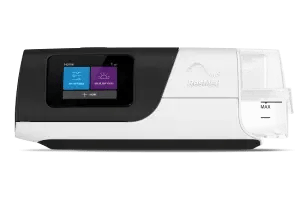
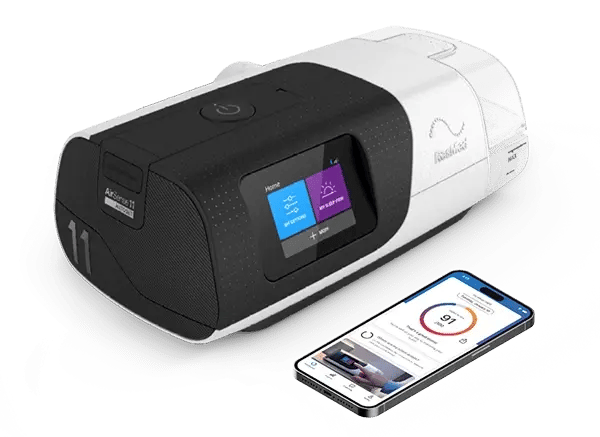



AutoSet™ technology
Changes in sleep stage, weight, body position, and other factors can alter a patient’s airway pressure treatment requirements from night to night, hour to hour and breath to breath. At times they may need higher pressure to maintain airway patency, and at times their pressure needs may be lower. Resmed’s AutoSet™ automatic positive airway pressure (APAP) devices monitor a patient's airway on a breath-by-breath basis and deliver only the pressure that patients need—when they need it.
- Our AutoSet devices are designed to provide the minimum pressure required at each point in time to treat apneas/hypopneas and upper airway resistance.
- Patients report better subjective sleep and achieve a significant reduction (37%) in median treatment pressure with consequently lower system leaks than fixed-pressure therapy (CPAP).1
- Patients on treatment pressures of 10 cm H2O or higher, or who have side effects from CPAP treatment, experience more benefit from auto-adjusting therapy such as AutoSet.2,3,4
- Resmed’s AutoSet devices use a patented algorithm that responds to flow limitation (the earliest sign of impending airway collapse), snoring and apnea on a breath-by-breath basis.5-6
Reference
Teschler H, Wessendorf TE, Farhat AA, Konietzko N, Berthon-Jones M. Two months auto-adjusting versus conventional nCPAP for obstructive sleep apnoea syndrome Eur Respir J 2000;15(6):990-5.
Hukins C. Comparative study of auto titrating and fixed-pressure CPAP in the home: a randomized, single-bond crossover trial. Sleep 2004;27(8):1512-7.
Resta O, Carratu P, Depalo A, Giliberti T, Ardito M, Marrone O, Insalaco G. Effects of fixed compared to automatic CPAP on sleep in Obstructive Sleep Apnoea Syndrome. Monaldi Arch Chest Dis 2004;61(3):153-6.
Massie CA, McArdle N, Hart RW, Schmidt-Nowara WW, Lankford A, Hudgel DW, Gordon N, Douglas NJ. Comparison between automatic and fixed positive airway pressure therapy in the home. Am J Respir Crit Care Med 2003; 167(1):20-3.
Ayappa I, Norman RG, Hosselet JJ, Gruenke RA, Walsleben JA, Rapoport DM. Relative occurrence of flow limitation and snoring during continuous positive airway pressure titration. Chest 1998;114(3):685-90.
Farre R, Montserrat JM, Rigau J, Trepat X, Pinto P, Navajas D. Response of automatic continuous positive airway pressure devices to different sleep breathing patterns: a bench study. Am J Respir Crit Care Med 2002;166(4):469-73.
More research
Noninvasive ventilation for COPD patients
Read a selection of research articles on the topics of bilevel therapy and noninvasive ventilation. ...
Sleep apnea and cardiovascular issues
Further explore research topics on cardiovascular disease and its connection to sleep apnea and ...
Sleep therapy compliance
Read about research on compliance in relation to positive airway pressure ...
Diabetes and sleep apnea
Explore research about diabetes in relation to sleep and respiratory ...